MaxSax : Chords
on the Saxophone
Back to ColinGleason.com for links to original music
Main Goal: create a device to play chords on the saxophone.
Subgoal: create a version that costs less than $50 of parts. (soldering and assembly still necessary)
Overview of functionality
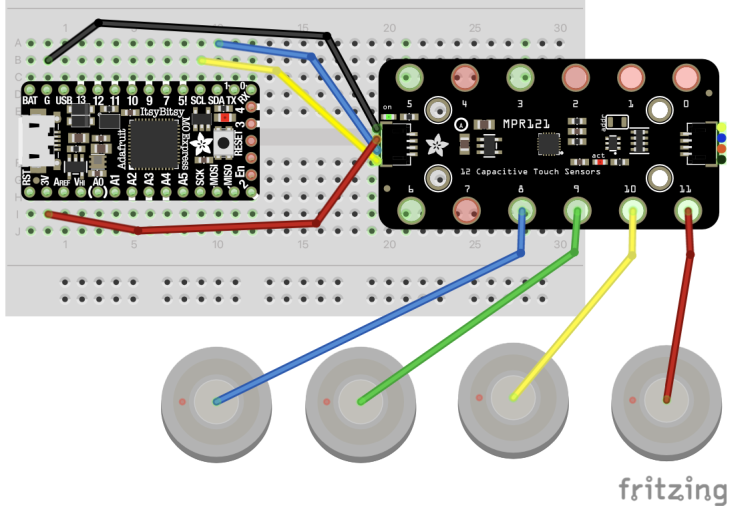
The MaxSax is a hardware/software D.I.Y. kit that will add a set of touch-sensitive copper sensors on top of your existing saxophone keys to send data through an Arduino-compatible microprocessor through a software program called Max/MSP into a DAW (such as Ableton) with MIDI to allow you to add chords to the moving roots (and thirds/fifths/sevenths!) of your live saxophone.
This is facilitated by using custom pedalboards to select the quality (major7 / minor7 / dominant7 / sus7 / half-diminished7 / augmented7 / minor-major7) and inversion (root / 1st /2nd/ 3rd) to allow you to create chording patterns live.
You may also switch Midi channels live too, allowing you to comp with a Rhodes, and then lay down a bass part, or drum part, or arpeggiate through some sawtooth or squarewave synths as you wish.
Coming Soon!
RNBO embedded patch
RNBO (pronounced “Rainbow”) is a version of Max/MSP that can be placed on a standalone unit (like a Raspberry Pi) or embedded onto a website (like this one!!)
I am working on a version of the current full patch that will demonstrate how the software works from a hands-on point-of-view. While the hardware requires a fair amount of soldering and assembly, I plan to release a RNBO patch that will use the QWERTY keyboard to demonstrate how some of the sounds/chords/inversions sort of feel/work. Stay tuned!!
Live show/demo
Main Goal: present the working version in front of a live audience.
This will feature multiple visual elements to show what is happening:
** the footpedals (live video feed)
** saxophone fingering (live video feed)
** Max/MSP screen
** Ableton Live screen.
Similarities / Differences with other windsynths
The Synthophone:
The MaxSax device is similar to a Synthophone in that it will produce chords as determined by a musician using a MIDI-instrument that is based on standard saxophone fingering.
It differs from the Synthophone, in that the device rests on top of the keys of a traditional saxophone and doesn’t stop the “analog saxophone” from producing it’s classic true saxophone sound.
The Yamaha WX5:
The Akai EWIs:
The Yamaha YDS-120/150:
The Roland Aerophone AE-20:
The MaxSax device is similar to these in that it provides notes via MIDI to a DAW by an entry-method using standard saxophone fingering.
The MaxSax device differs from these in that it also allows the user to play chords via the DAW, and it also maintains that sonic qualities of the original (“analog”) saxophone.
Timeline of Development:
2016 Spring: Creation of the MaxSax Chord function (used on a patch that sampled from Magnum, P.I. theme) Non-Linear Self Production
2017 Summer: First course in Programming for Max
2019 Fall: all: Jitter course added visuals
2022 Summer: Circuit Bending course: started to do physical computing, looking into Arduinos and creating circuit bent toys… which would lead to creating the physical sensors on the saxophone
2023 Summer: Live Performance for the Electronic Musician brought the idea of a physical device that turned a saxophone into a reactive chord to full consiousness… and the next 2+ years of R+D began to make that idea into a reality.
2025 Spring: First Arduino patch (“apr07”) transmits actual data from touch-sensitive copper discs applied to the tenor saxophone. This followed from several years of tinkering and learning the basics of electronics and coding. I immediately wrote down the success in no less than four separate journals, and then managed to overwrite the code without saving the working version safely enough to reference. This was a life-lesson I would have preferred to have avoided, but I know if I could cobble the code successfully once, I will be able to do it again. Meanwhile, I turned to more software developments and worked on the various pedal options to trigger the chords and the inversions.
 Colin Gleason ~ Saxophones